
THE PRACTICAL GUIDE TO SUCCESSFUL IMPORTING FROM ASIA
Importing. Private Label. Manufacturing in Asia.
395 pages. 12 parts. More than 90 chapters.
Built on 15 years of real-world sourcing experience.
Avoid costly mistakes and quality failures
Find the right suppliers and negotiate better pricing
Conduct inspections that protect your business
Develop products that sell—and scale
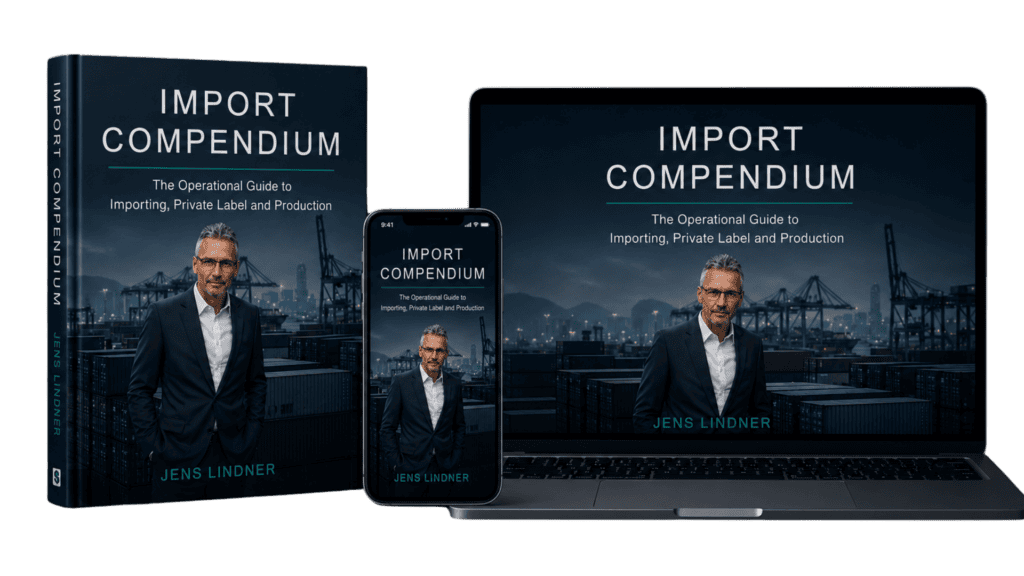
NOW AVAILABLE
Get the Import Compendium In Your Preferred Format
Kindle Edition
Instant download.
Read on Kindle, iPhone, iPad, Android, Mac, or PC.
Secure checkout through Amazon
7-day Kindle return policy
Practical and immediately actionable
Built for importers, brand owners, and sourcing professionals
Proven frameworks, templates, and checklists included
Save time, reduce risk, and increase profitability
🎧 FREE AUDIOBOOK
Listen to the Import Compendium – For Free
Get the Import Compendium now as a free audiobook – delivered directly to your smartphone or computer.
Note: The audiobook provides a compact overview of the most important content. All templates, illustrations, and detailed step-by-step instructions can only be found in the Kindle and paperback edition.
🏆 AMAZON BESTSELLER
No. 1 Bestseller in Three Amazon Categories
Shortly after its release, The Import Compendium reached No. 1 in three Amazon Germany categories—a strong indication of how valuable practical, real-world sourcing knowledge is to today's importers and business owners.
#1 BESTSELLER
in the category
Purchasing, Production & Logistics
#1 BESTSELLER
in the category
Quality Management
#1 BESTSELLER
in the category
Negotiation
📷 VERIFIED ON AMAZON GERMANY

Amazon Bestseller Ranking in Purchasing, Production & Logistics

Amazon Bestseller Ranking in Quality Management

Amazon Bestseller Ranking in Negotiation
Awarded the No. 1 Bestseller status on Amazon Germany in Purchasing, Production & Logistics, Quality Management and Negotiation categories.
— 02 — WHAT THEY DON'T SHOW YOU
What They Don't Show You on YouTube
Importing doesn't require inspiration. It doesn't require elegance. It requires repeatability. And that's surprisingly rare.
For more than fifteen years, I've worked between Asia and Europe. I've overseen container shipments, visited factories, selected manufacturers—and replaced them when necessary. I've organized audits, resolved customs issues, argued over inspection reports, negotiated contracts, and defended businesses against compliance claims.
Over the years, I've learned one thing: most mistakes in the import business aren't unique. They're the same three or four mistakes, repeated over and over again in slightly different forms. With remarkable consistency. And at a remarkably high cost.
YouTube tutorials show the success stories. The winning case studies. The before-and-after slides. What they don't show you are the €12,000 mistakes caused by the wrong Pantone code. The three months lost because a trading company outsourced production to four different factories. Or the $47,000 settlement paid after receiving a 60-Day Notice from California.
This book is about the other side of the business. What happens when theory collides with reality—and what you can do to make sure you're not the next person telling that story.
— Jens Lindner, Hongkong
— 03 — WHY 95% PAY THE PRICE OF EXPERIENCE
95% of First-Time Importers Pay for Their Lessons. The Only Question Is How Much.
After 15 years of consulting, I continue to see the same eight mistakes repeated over and over again. Depending on the situation, they can cost anywhere from €5,000 to €200,000 in accumulated worst-case losses. None of them are unusual. All of them are preventable. Yet they keep happening.
1
You Optimize the Product, Not the Process
"What niche should I enter? What's the next trend? Where are the gaps in the market?" Wrong focus. A good product is not a competitive advantage—it's the price of admission. The real advantage comes from sourcing, quality control, logistics, negotiation, and execution. If you're only optimizing the product, you're working on the most visible and least powerful lever in the entire system.
2
You Believe the Tutorials
Success stories dominate YouTube. What you rarely see are the failed attempts, the small deviations, and the mistakes that end up costing five-figure sums. The result is a distorted picture: the process looks clean, predictable, and easy to replicate. It isn't.
3
Your Cost Calculation Is Too Optimistic
Defective products. Rework. Cash flow disruptions caused by shipping delays. Marketing expenses. Pricing pressure. Just because a cost isn't included in your spreadsheet doesn't mean it won't show up. The initial calculation is rarely wrong—it is usually too optimistic. And optimism is not a reliable business strategy in importing.
4
You Confuse Quality with Hope
"The supplier will get it right." That's not quality management. It's wishful thinking. Without clear specifications, inspections, and feedback loops, quality doesn't exist. What you get instead is interpretation. And interpretation almost always becomes expensive the first time around.
5
You Discover Problems Too Late
A production issue identified during manufacturing may cost $200 to fix. The same issue after production may cost $2,000. Inside a container, it can cost $20,000. Once the goods reach your warehouse, it may cost $80,000—plus the loss of an entire Q4 launch. The most expensive mistake isn't the mistake itself. It's when you discover it.
6
You Put Everything on One Card
One product. One supplier. One order. One expectation. It may seem efficient, but it's incredibly fragile. Experienced importers think in scenarios and contingencies. Beginners think in bets. The difference becomes obvious the moment something goes wrong.
7
You Move Too Fast
The business appears fast-moving, so decisions are made quickly. Due diligence is shortened. Details are overlooked. Contracts are signed without reading the attachments. Three months later, the container arrives—and with it, the invoice for every shortcut that was taken. At that point, correction is no longer an option. Impatience is one of the most expensive traits in the import business.
8
You Underestimate the Competition
You believe a great product will sell itself. It won't. Profitable niches are copied quickly—often within months. If your business is defined only by the product and not by your brand, distribution, or customer relationships, you'll eventually end up in a price war. And price wars are won by whoever has the lowest unit cost. That is rarely the European importer.
No one fails because of a single catastrophic mistake. Businesses fail because of a chain of small mistakes made under pressure. This book explains exactly how those chains are formed—and, more importantly, how to break them before they become expensive.
— 04 — THREE CONSULTING CASES
Three Cases. €80,000 in Losses. Every One of Them Preventable.
Real cases from consulting engagements. Anonymized, but operationally accurate. Each one is paired with the chapter that explains exactly how to prevent it.
TOTAL LOSSES ACROSS THREE CASES
€80,000 — all of it preventable.
18.000 €
40.000 €
22.000 €
Case 2 · Proposition 65 Notice
Case 3 · Negotiation Breakdown
Case 1: The Supplier That Doesn't Actually Exist
An importer finds a supplier on Alibaba. Gold Supplier status. Seven years on the platform. Trade Assurance. ISO 9001 certification displayed on the profile. The inquiry process goes smoothly. Pricing looks reasonable. Responses arrive within 24 hours. A 30% deposit is sent.
Three weeks later, the samples arrive. They look fine. Seven weeks later, the container arrives. The shipment contains products from three different quality levels. The ISO 9001 certificate turns out to belong to a different company. The supposed manufacturer is actually a trading company operating from an office building in Shenzhen, sourcing from four different factories.
Damage: A 30% deposit lost deposit, three months of delay, and a missed seasonal product launch.
Case 2: The Kitchen Spatula That Cost $47,000
A German importer sources a stainless-steel kitchen spatula with a black silicone handle from China. The supplier confirms that the product is "FDA food grade." The product sells successfully on Amazon US for six months.
Then a letter arrives. A California-based bounty hunter has independently tested the handle in a private laboratory and discovered 0.15% DEHP, a plasticizer. Under European REACH regulations, the level remains just below the applicable threshold. In California, however, Proposition 65 requires a warning label for products containing the substance. The warning is missing. Settlement amounts in similar cases typically range between $20,000 and $50,000, plus legal fees.
The FDA certificate offers no protection. The REACH certificate offers even less.
The importer ultimately pays a $47,000 settlement, $11,000 in legal fees, and loses three weeks of sales.
Damage: $58,000 plus lost Q3 revenue on the company's most profitable sales channel.
Case 3: The Negotiation That Collapsed in Round Three
An importer flies to Shenzhen for negotiations. After three days, everything appears settled. Price. MOQ. Payment schedule. Then, on the evening before the contract signing, the Chinese counterpart says: "Unfortunately, my boss didn't approve this. We need to revisit point X."
The boss was never present during negotiations. Everything that had already been agreed upon is suddenly back on the table. The return flight leaves in 18 hours. Under time pressure, the importer accepts worse terms. Higher MOQs. Less favorable payment conditions. Longer lead times. In Chinese negotiation practice, this tactic has a name: "The Headless Horseman." It is one of twelve recurring negotiation patterns.
Damage: Purchasing conditions deteriorate by 14%, combined with an additional two months of lead time. Conservatively calculated, the result is a €22,000 reduction in margin.
— 05 — WHAT YOU'LL BE ABLE TO DO AFTER READING IT
Not Just Better Informed. Operationally Capable.
This is not a theory-heavy business book. It's a practical toolkit. Every major chapter ends with checklists, templates, and actionable frameworks. Read it over the weekend, and you'll walk into the office on Monday with a completely different perspective.
Identify a Trading Company in Under 30 Minutes
Seven verification steps using business licenses, ISO validation, Baidu Maps location checks, and live video factory audits. Plus the three questions every real manufacturer can answer within an hour—and every trading company struggles to answer for days.
Negotiate MOQs Down by 20–40% Without Losing the Supplier
Learn the arguments Chinese suppliers actually respect—cash flow, pilot orders, and future business volume. Understand which arguments carry no weight at all. Plus the payment structure that neutralizes almost every MOQ objection.
Survive a California 60-Day Notice Without a $50,000 Settlement
A step-by-step action plan for the day the notice arrives. Plus two proven strategies importers use to eliminate the risk before the first shipment ever reaches Amazon US.
Read a Pre-Shipment Inspection Report and Know What Actually Matters
Understand AQL standards. Distinguish critical defects from minor defects. Learn how to identify the single section of an inspection report that determines whether a shipment should be accepted or rejected.
Scale Without Watching Your Second Order Become Worse Than Your First
Supplier lifecycle management. Quality drift prevention. Margin protection. Risk diversification across China, Vietnam, and India. Learn how to turn a successful first shipment into a business that remains profitable—even during difficult market conditions.
Write Supplier Briefings That Can't Be “Creatively Interpreted”
Product specifications. Materials. Tolerances. Pantone colors. Packaging requirements. Labeling standards. Includes the same briefing framework used internally by Asiapro for six-figure sourcing projects, plus the one critical detail missing from 90% of supplier briefs that later causes expensive disputes.
Understand CE, GPSR, PPWR, and REACH—And Know What You Actually Need
Which requirements apply at different sales volumes. What belongs in your technical documentation. Which tests are legally relevant—and which are merely expensive theater. Includes a list of certifications that look impressive but provide little or no legal protection.
Recognize Chinese Negotiation Tactics and Control the Outcome
Twelve named negotiation tactics with practical counterstrategies. Including the three phrases Chinese negotiators rarely hear—and that often change the tone of a negotiation immediately.
Calculate Tariff Classifications Before They Destroy Your Margin
Learn how a ten-digit HS code can turn a profitable product into a loss-maker—or the other way around. Includes the adjustment that, in roughly 30% of cases, can reduce import duties significantly without raising objections from customs authorities.
— 06 — TABLE OF CONTENTS
395 Pages. 12 Parts. More Than 90 Chapters. No Filler.
Open the book and you won't find 50 pages of introductions, motivation, or theory. By page 15, you're already in the operational details. Here's how it's structured.
PART 01
Fundamentals and Reality
Fundamentals and Reality
Why importing looks easier than it is | Why most importers fail | Trading products vs. private label | Capital, time, and expectations | Business models at a glance
PART 02
Product and Strategy
Product and Strategy
PART 03
Sourcing and Suppliers
Sourcing and Suppliers
PART 04
Production Preparation
Production Preparation
PART 05
Sampling and Validation
Sampling and Validation
PART 06
Production and Quality
Production and Quality
PART 07
Legal and Regulatory Compliance (EU & USA)
Legal and Regulatory Compliance (EU & USA)
PART 08
Packaging and Extended Producer Responsibility (EPR)
Packaging and Extended Producer Responsibility (EPR)
PART 09
Logistics and Import Operations
Logistics and Import Operations
PART 10
Negotiation and Risk Protection
Negotiation and Risk Protection
PART 11
Reordering
Reordering
PART 12
Scaling and Lifecycle Management
Scaling and Lifecycle Management
— 07 — WHO THIS BOOK IS FOR — AND WHO IT ISN'T
Not Every Book Is for Everyone. This One Isn't Either.
This Book Is for You If:
You're planning your first or second sourcing project and understand that the cost of mistakes is always higher than the cost of knowledge.
You're an Amazon FBA seller who wants to move beyond interchangeable commodity products and build a more defensible business.
You're building a private-label brand and need supplier briefings, contracts, and quality-control frameworks that don't come from a guru's blog.
You import B2B products and need to navigate compliance requirements in the EU and the United States because your customers expect it—and your business depends on it.
You already work with suppliers in China and want to understand why your last three negotiations didn't go the way you expected.
You're looking to diversify sourcing into Vietnam or India and need a practical framework for evaluating your options.
This Book Is Not for You If:
You're looking for a blueprint that promises to turn you into a six-figure Amazon seller in 90 days. It doesn't exist. Anyone who claims otherwise is either lying or trying to sell you a course.
You're looking for motivational content. This book is practical, detailed, and often highly technical.
You're expecting personalized legal advice. This is a field guide for practitioners, not a replacement for an attorney.
You enjoy theory more than execution. This book is built the other way around.
— 08 — ABOUT THE AUTHOR

Who Wrote This — And Why He Knows What He's Talking About
Jens Lindneris the co-founder of ASIAPRO, headquartered in Hong Kong. He has been based in Asia since 2013 and specializes in product development, sourcing, and operational support for European importers.
His experience includes more than 1,200 client projects across industries ranging from consumer electronics, household goods, and furniture to lifestyle products and FMCG. ASIAPRO handles thousands of containers per year, with dedicated teams in Shenzhen, Ho Chi Minh City, and Delhi. Audits, pre-shipment inspections, and negotiation support are part of Jens's day-to-day work—not theoretical concepts.
The Import Compendium is the condensed version of what ASIAPRO clients typically pay for through consulting engagements. 395 pages of knowledge that would normally sit behind a five-figure consulting invoice. It was published for one simple reason: At some point, writing it all down became more efficient than explaining the same costly mistakes to every new importer one by one.
— 09 — THE BOOK
Print. Kindle. Everything Included. No Membership Required.
Du bekommst das komplette Import Compendium als Kindle-Ebook am 2. Juni 2026 für 9,99 €. Lesbar auf jedem Gerät. Die Paperback-Ausgabe folgt zwei Wochen später.
Instant Delivery · Available on July 1, 2026
Read Anywhere · Kindle, iPhone, iPad, Android, Mac, and PC
Templates Included · Supplier briefings, NNN clauses, inspection checklists, and practical implementation tools
— 10 — WHAT'S INSIDE THE BOOK
What's Included in This Book That Others Sell Separately
Supplier Validation Checklist (7-Step Framework)
A practical supplier verification system covering business licenses, certifications, factory verification, and risk indicators. Often sold elsewhere as a "Supplier Audit Template" for €49 or more.
NNN Agreement Clause Builder
A framework for protecting intellectual property, supplier relationships, and manufacturing know-how when sourcing in China. Law firms in Hong Kong commonly charge between $1,500 and $3,000 to draft comparable agreements.
RFQ Template with Required and Optional Fields
Most sourcing briefs are incomplete. In fact, roughly 80% omit information that later creates misunderstandings, delays, or quality problems. This template closes those gaps and creates a structured request-for-quotation process suppliers can actually work with.
Pre-Shipment Inspection Report Guide
Learn how to interpret inspection reports correctly. Includes: AQL standards explained Critical vs. non-critical defects Acceptance and rejection criteria The sections of a report that actually matter
Proposition 65 Crisis Playbook
A practical four-step response plan for the day a California Proposition 65 notice arrives. Legal research on this topic can easily cost $800 per hour or more.
HS Code Optimization Cheat Sheet
Learn how tariff classifications affect profitability. Includes practical guidance on how a different ten-digit classification can legally reduce import duties and improve margins without creating customs compliance issues.
— 11 — RISK
At $9.99, You Don't Need a Guarantee. But You Have One Anyway.
Amazon Kindle allows eBooks to be returned within seven days, provided less than 10% of the book has been read. That's standard Amazon policy—not a goodwill gesture from ASIAPRO.
Realistically speaking, spending $9.99 on 395 pages of practical importing knowledge is hardly a risk. The real risk is ignoring the book and learning the lessons the expensive way: At the container. Instead of in your chair.
— 12 — FAQ
Frequently Asked Questions.
No. Amazon FBA is just one application. The book covers a much broader range of importing topics. Wholesale businesses, traditional e-commerce brands, and B2B importers will benefit just as much.